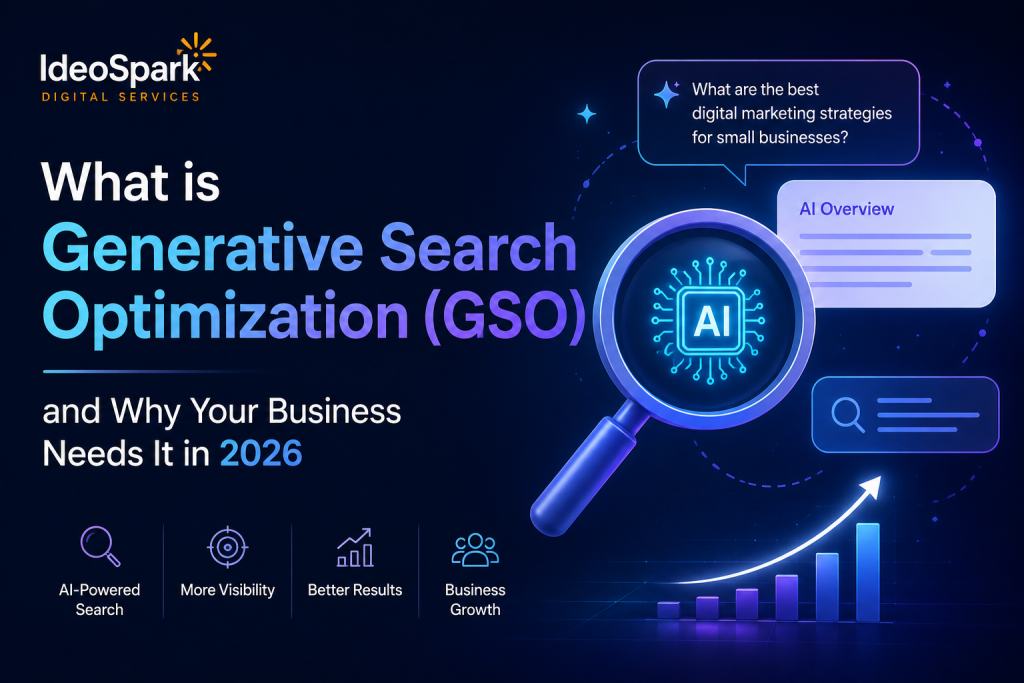
What is Generative Search Optimization (GSO)
Why Your Business Needs It in 2026
That’s not a prediction. That’s the reality of search in 2026. And the discipline that determines whether AI recommends you or your competitor has a name: Generative Search Optimization — GSO.
In this guide, IdeoSpark breaks down exactly what GSO is, why traditional SEO is no longer enough, and the proven strategies that get your business cited inside ChatGPT, Google AI Overviews, Perplexity, and Microsoft Copilot.
1. What is Generative Search Optimization (GSO)?
Generative Search Optimization is the systematic practice of structuring your brand’s online presence so that AI-powered search engines can easily find, understand, and cite your business inside their synthesized answers.
GSO brings together three previously separate disciplines into one unified framework:
- GEO — Generative Engine Optimization — Getting your content retrieved and cited by AI engines like ChatGPT, Perplexity, and Gemini.
- AEO — Answer Engine Optimization — Structuring content so AI engines can extract clean, direct answers to user questions.
- LLMO — Large Language Model Optimization — Associating your brand name with the right attributes inside the model’s own learned understanding of the world.
In traditional SEO, the goal was to rank #1. In GSO, the goal is to be the source the AI quotes. That’s a fundamentally different objective — and it requires a fundamentally different strategy.
📌 The Core Difference
Traditional search: rank a page → user clicks → user reads. Generative search: AI reads every page → AI synthesizes one answer → AI cites two or three sources. If you’re not one of those sources, the user never sees you.
2. Why GSO Matters More Than Any Marketing Trend in Years
The numbers below are from early 2026 tracking data. They represent a fundamental shift in where your customers are looking for you.
|
900M Weekly active users on ChatGPT — up from 400M in 2025 |
48% Of all Google searches now trigger an AI Overview above the results |
44% Of consumers use AI search as their primary product discovery channel |
|
70% Of searches now end on the search page with zero clicks to any website |
32.5% Conversion rate for visitors arriving via AI citation — vs ~3% for standard search |
0.64% Organic click-through rate on Google results — down from 1.41% year-over-year |
Read that last stat again. Traffic that arrives from an AI citation converts at up to 32.5% — roughly 10 times the rate of a normal Google visitor. AI search doesn’t just send you traffic. It sends you buyers.
And if your business isn’t there? Your competitor is. Every AI answer that mentions another brand in your category — without mentioning you — is a customer who never knew you existed.
3. How AI Search Engines Decide Who to Cite
AI doesn’t rank websites the way Google does. It processes your content as meaning — and then decides whether your brand is trustworthy and relevant enough to cite in front of millions of users. Each major AI search platform has its own sourcing logic:
|
Platform |
How It Sources Answers |
What It Prefers |
Conversion Rate |
|
ChatGPT |
Bing API + trained knowledge |
Comprehensive guides, authoritative domains, recent content |
15.9% — drives 87% of AI referral traffic |
|
Perplexity |
Real-time crawl of 200B+ URLs |
Original data, community reviews, direct answers |
10.5% |
|
Google Gemini / AI Overviews |
Google’s core search index |
Top organic rankings, FAQ schema, YouTube content |
3.0% |
|
Microsoft Copilot |
Bing index + enterprise workflows |
LinkedIn presence, fast-loading pages, B2B authority |
17× the rate of direct web traffic |
|
Anthropic Claude |
Parametric knowledge + web consensus |
Balanced, expert-authored, long-form analytical content |
5.0% |
|
⚠️ The Earned Media Blind Spot Research across 11,500 AI search queries found that every major AI engine systematically favours third-party reviews, news coverage, and independent analysis over brand-owned content. If your website is the only place that talks about how good you are, AI will ignore you. You need other voices saying it too. 4. GSO vs. Traditional SEO: What’s the Same and What’s DifferentGSO doesn’t replace traditional SEO. It sits on top of it. Google’s official guidance confirms that AI Overviews still pull from the core search index. Strong foundational SEO remains the prerequisite for AI visibility. What changes is the layer above it.
5. What Actually Works: GSO Strategies Backed by ResearchA landmark study from Princeton (Aggarwal et al., 2024) tested nine content optimization strategies across 10,000 AI search queries. The results are clear and actionable. The 5 Strategies That Deliver Results
6. The Technical Side of GSOBeyond content, there are technical signals that directly determine how well AI systems can read and cite your website. These are foundational infrastructure for AI visibility.
7. Real Businesses. Real GSO Results.GSO is not theoretical. These are documented outcomes from businesses that implemented it in 2025–2026.
8. How IdeoSpark’s SEO + GSO Service WorksAt IdeoSpark, our SEO and GSO service is a systematic, evidence-based programme built specifically to get your business cited by AI search engines — while maintaining and growing your traditional organic rankings.
9. When Should Your Business Start With GSO?The honest answer is: the best time was six months ago. The second-best time is right now. AI search is not a coming trend. It is the current reality for 900 million weekly ChatGPT users, 750 million Gemini users, and growing. Every week you are not optimized for AI citation is a week your competitors have a chance to establish authority in the AI model’s understanding of your industry — authority that compounds and becomes harder to displace over time. The good news: most businesses in your market have not started yet. The window for early-mover advantage in GSO is still open — but not indefinitely.
|